> ## Documentation Index
> Fetch the complete documentation index at: https://docs-staging-docs-ia-custom-database-connections.mintlify.site/llms.txt
> Use this file to discover all available pages before exploring further.
# How to Create Custom Database Connections
> Use your own external user store as an IdP in Auth0 by creating a custom database connection.
If you have your own external user store, you can use it as an identity provider in Auth0 to authenticate users.
To do so, first you connect Auth0 to your external user store by creating a custom database connection, then you write database action scripts to define how Auth0 interfaces with your user store. We provide database action script templates for several common databases:
* MongoDB
* MySQL
* PostgreSQL
* Microsoft SQL Server
* ASP.NET Identity
* Web services accessed with Basic Auth
You can modify these templates or write your own entirely to connect to any kind of external user store.
## Instructions
* Your external user store must be reachable from Auth0's servers. If it is behind a firewall, allow inbound traffic from [Auth0's outbound IP addresses](/docs/secure/security-guidance/data-security/allowlist).
* Your external user store must have the appropriate fields to store [normalized user profile attributes](/docs/manage-users/user-accounts/user-profiles/normalized-user-profile-schema), such as `id`, `nickname`, `email`, and `password`.
* The `id` (or `user_id`) value returned from your database action scripts must be unique across all custom database connections because Auth0 uses this value to [identify users](/docs/manage-users/user-accounts/identify-users).
To avoid user ID collisions when using multiple custom database connections, we recommend prefixing `id` values with the connection name (omitting whitespace).
From [**Auth0 Dashboard > Authentication > Database**](https://manage.auth0.com/#/connections/database), select **+ Create DB Connection**. On [the **New Database Connection** page](https://manage.auth0.com/#/connections/database/new), enter the following configuration.
* Enter a name, which must:
* Contain only alphanumeric characters and dashes.
* Start and end with an alphanumeric character
* Not exceed 35 characters.
* Choose one or more [attributes](/docs/authenticate/database-connections/activate-and-configure-attributes-for-flexible-identifiers) as user identifiers.
* Choose one or more authentication methods (like [passwords](/docs/authenticate/database-connections/flexible-password-policy) or [passkeys](/docs/authenticate/database-connections/passkeys)).
* Enable the **Use my own database** toggle.
When you're done, select **Create**. Auth0 creates the database connection and redirects you to its configuration page.
Once you create your custom database connection, you need to write [database action scripts](/docs/authenticate/database-connections/custom-db/custom-database-connections-scripts) to define how Auth0 interfaces with your external user store for functionality like login, sign up, email verification, password resets, and user deletion.
At minimum, you must implement a [Login script](/docs/authenticate/database-connections/custom-db/templates/login):
1. From the database connection's page, select the **Custom Database** tab.
2. In the **Database Action Scripts** section, select **Login**.
3. Write your own database action script with the provided function signature, or use the **Load Template** drop-down menu to select a template to start from.
For example, the MySQL Login action script template looks like this:
```js expandable Login database action script template for MySQL theme={null}
function login(identifierValue, password, callback) {
const mysql = require('mysql');
const bcrypt = require('bcrypt');
const connection = mysql.createConnection({
host: 'localhost',
user: 'me',
password: 'secret',
database: 'mydb'
});
connection.connect();
const query = 'SELECT id, nickname, email, password FROM users WHERE email = ?';
connection.query(query, [ identifierValue ], function(err, results) {
if (err) return callback(err);
if (results.length === 0) return callback(new WrongUsernameOrPasswordError(identifierValue));
const user = results[0];
bcrypt.compare(password, user.password, function(err, isValid) {
if (err || !isValid) return callback(err || new WrongUsernameOrPasswordError(identifierValue));
callback(null, {
user_id: user.id.toString(),
nickname: user.nickname,
email: user.email
});
});
});
}
```
This example assumes the database contains a `users` table containing the appropriate columns. The script connects to the database, uses a query to retrieve the first user with `email == user.email`, validates the entered passwords with `bcrypt.compareSync` and, if successful, returns an object containing the user profile information (including `id`, `nickname`, and `email`).
All database action scripts must call the Auth0-supplied [`callback` function](/docs/authenticate/database-connections/custom-db/custom-database-connections-scripts#callback) exactly once, immediately before it completes (either implicitly or explicitly with a `return` statement).
In the **Configuration Parameters** section (below **Database Action Scripts**), you can store values that are available to all database action scripts in the global `configuration` object.
Values are encrypted, so you can also use configuration parameters to store sensitive information such as credentials or API keys for accessing external identity stores or define variables with tenant-specific values.
To extend the previous MySQL example, if you add the **Key** `MYSQL_PASSWORD` with the **Value** as the MySQL password, you can use that configuration parameter to connect:
```javascript MySQL connection configuration parameter example theme={null}
const connection = mysql.createConnection({
host: 'localhost',
user: 'me',
password: 'secret', // [!code --]
password : configuration.MYSQL_PASSWORD, // [!code ++]
database: 'mydb'
});
```
Treat the `configuration` object as read-only and use it to avoid hard-coding values in your action scripts.
1. To test your database action script, select **Save and Try** above the code block.
2. In the **Try the login script** window that opens, enter the user credentials you want to use to test.
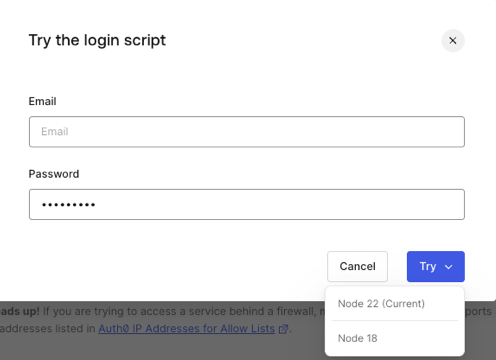 3. Select **Try** to open the runtime selector. Choose your runtime to execute the script.
You can [change the default NodeJS runtime](/docs/get-started/tenant-settings#extensibility) in your tenant settings.
When you're done, close the **Try the login script** window, then select **Save** to save the script.
## Next steps
### Enable automatic migration
You can continue using your external user store as your IdP. If you want to transition to Auth0's user store instead, you can [incrementally migrate users to Auth0](/docs/manage-users/user-migration/configure-automatic-migration-from-your-database) (sometimes called *trickle* or *lazy* migration).
### Enable Organization context
If you use custom database connections with [Organizations](/docs/manage-users/organizations), you can make Organization details like `id`, `name`, and `metadata` available to your database action scripts by enabling [the `context` object](/docs/authenticate/database-connections/custom-db/custom-database-connections-scripts#context-object)
Doing so passes an additional `context` argument to custom database scripts containing Organization data. For example, when a user authenticates on an Organization’s login prompt, the login database action script is passed.
You cannot disable the `context` object after you enable it.
First, enable the `context` object:
1. From to [Auth0 Dashboard > Authentication > Database](https://manage.auth0.com/dashboard/us/#/connections/database/), select your database connection.
2. Select the **Custom Database** tab.
3. Next to **Context object in database scripts**, select **Enable**.
4. In the **Are you absolutely sure?** window that opens, select **Confirm**.
Next, add the `context` object to your database action scripts. This parameter directly precedes the `callback` parameter. For example, in the Login script function signature:
```js Original Login script function signature theme={null}
function login(email, password, callback) { ... }
```
```js Login script function signature with the context object theme={null}
function login(email, password, context, callback) { ... }
```
The `context` object contains Organization data in the following format:
```json lines theme={null}
{
"organization": {
"display_name": "My Organization",
"id": "org_XXXXXX",
"metadata": {
"example": "value"
},
"name": "my-organization"
}
}
```
When events are triggered with Organization context, the corresponding data is made available to all database action scripts except the [Delete script](/docs/authenticate/database-connections/custom-db/templates/delete), which is always passed an empty `context` object.
## Limits and considerations
* Auth0 does not sanitize or validate any username/password combination passed by a custom database.
* Database action scripts are subject to Auth0's [Rate Limit Policy](/docs/troubleshoot/customer-support/operational-policies/rate-limit-policy).
3. Select **Try** to open the runtime selector. Choose your runtime to execute the script.
You can [change the default NodeJS runtime](/docs/get-started/tenant-settings#extensibility) in your tenant settings.
When you're done, close the **Try the login script** window, then select **Save** to save the script.
## Next steps
### Enable automatic migration
You can continue using your external user store as your IdP. If you want to transition to Auth0's user store instead, you can [incrementally migrate users to Auth0](/docs/manage-users/user-migration/configure-automatic-migration-from-your-database) (sometimes called *trickle* or *lazy* migration).
### Enable Organization context
If you use custom database connections with [Organizations](/docs/manage-users/organizations), you can make Organization details like `id`, `name`, and `metadata` available to your database action scripts by enabling [the `context` object](/docs/authenticate/database-connections/custom-db/custom-database-connections-scripts#context-object)
Doing so passes an additional `context` argument to custom database scripts containing Organization data. For example, when a user authenticates on an Organization’s login prompt, the login database action script is passed.
You cannot disable the `context` object after you enable it.
First, enable the `context` object:
1. From to [Auth0 Dashboard > Authentication > Database](https://manage.auth0.com/dashboard/us/#/connections/database/), select your database connection.
2. Select the **Custom Database** tab.
3. Next to **Context object in database scripts**, select **Enable**.
4. In the **Are you absolutely sure?** window that opens, select **Confirm**.
Next, add the `context` object to your database action scripts. This parameter directly precedes the `callback` parameter. For example, in the Login script function signature:
```js Original Login script function signature theme={null}
function login(email, password, callback) { ... }
```
```js Login script function signature with the context object theme={null}
function login(email, password, context, callback) { ... }
```
The `context` object contains Organization data in the following format:
```json lines theme={null}
{
"organization": {
"display_name": "My Organization",
"id": "org_XXXXXX",
"metadata": {
"example": "value"
},
"name": "my-organization"
}
}
```
When events are triggered with Organization context, the corresponding data is made available to all database action scripts except the [Delete script](/docs/authenticate/database-connections/custom-db/templates/delete), which is always passed an empty `context` object.
## Limits and considerations
* Auth0 does not sanitize or validate any username/password combination passed by a custom database.
* Database action scripts are subject to Auth0's [Rate Limit Policy](/docs/troubleshoot/customer-support/operational-policies/rate-limit-policy).